
Manufacturing facilities continue to raise their levels of automation to reduce costs, improve productivity, and increase operational efficiency. Newer automation technology also gives manufacturers something earlier fixed, or “hard,” automation never could: flexibility. For today’s manufacturers, flexibility is the new productivity.
Heavy load conveyance is where that shift bites hardest. Moving a vehicle body or an aircraft structure between assembly stations is not the same problem as delivering a tote of parts. The payload might weigh 20,000 lbs. It might be worth more than the machine carrying it. The vehicles built for this work, heavy-duty AGVs and unit load AGVs, have to be engineered accordingly.
Invio Automation designs and builds AGVs for this class of manufacturing: standard platforms rated to 66,000 lbs on deck or in tow, and custom vehicles engineered beyond that where the application calls for it, each built around the product rather than adapted to it.
Manufacturing Automation
Manufacturing automation can take many forms. Reprogrammable articulated robots, now including collaborative robots, are common among manufacturers of all types and sizes for applications such as welding, painting, and palletizing, and use cases like robotic vision inspection for quality checks continue to expand. Another manufacturing automation mainstay is conveyance: the act of transporting materials, parts, and other objects, and of moving items under construction through assembly lines for sequential manufacturing processes.
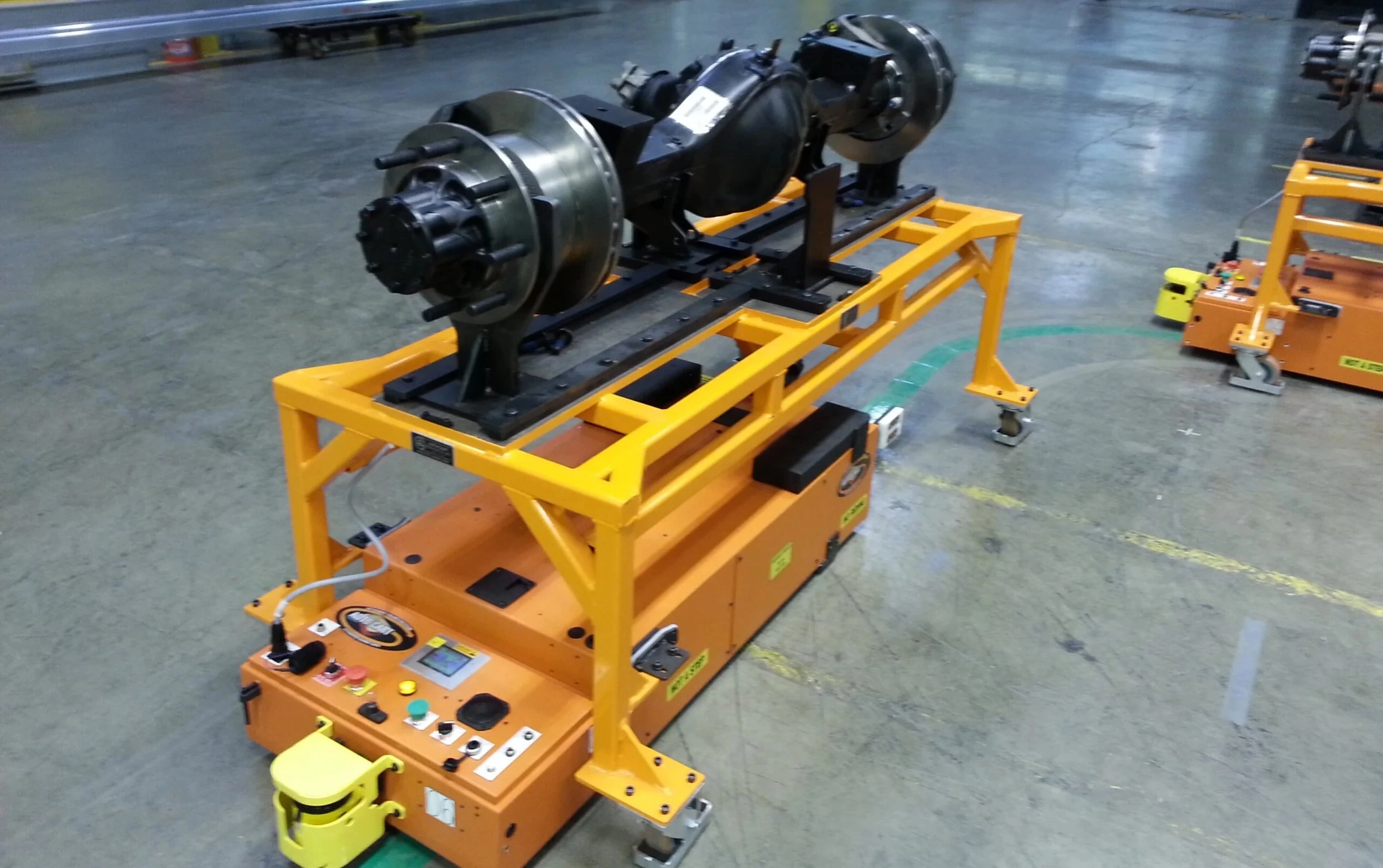
Conveyance Automation Types
Fixed Conveyance Systems
As their names imply, fixed conveyance systems are automation technologies that are immovable once in place, or can only be redeployed at the expense of disruption and great cost. Fixed conveyance systems such as belts, rollers, and overhead conveyors provide manufacturers with productivity benefits, but at the expense of flexibility. Towline conveyors (see below), commonly used for moving heavy loads in manufacturing facilities, are another form of fixed conveyance solution.
Flexible Conveyance Systems
Automation technologies that can be redeployed once installed. Automated guided vehicles and autonomous mobile robots (see below) are the leading examples. They deliver kitted materials to point-of-use on an assembly line and transport product like cars, trucks, and tractors through their assembly processes. AMRs are commonly used as a forklift alternative for lineside replenishment at electric vehicle, agricultural equipment, and medical device manufacturers, while AGVs have seen wide adoption among manufacturers of heavyweight products, where the safety case for automation over manual handling is strongest.
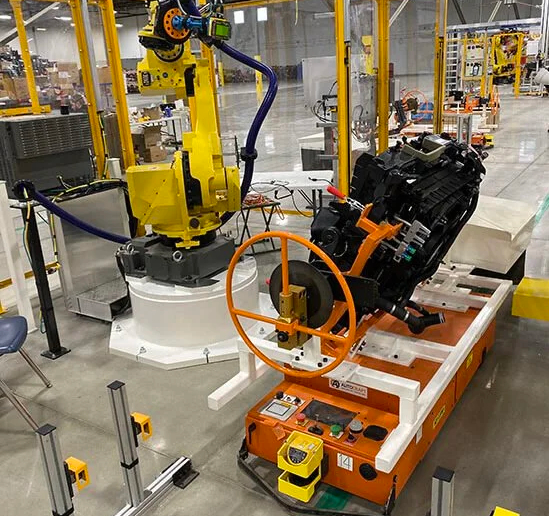
Prior to automated conveyance, items under manufacture were typically moved by hand using carts, trolleys, or forklifts. These manual methods were inefficient and often dangerous. Over time they were automated using several system types:
Towline Conveyors
Conveyors have been used in manufacturing plants for over 100 years. One form, the towline conveyor (also called tow conveyors, towveyors, build line conveyors, or trac-veyors), has found wide use in manufacturing processes that require constant forward motion for progressive operations. Most towline systems use a recessed chain to pull wheeled carts along a fixed path through sequential workstations.
Building one is a construction project. Deep trenching in the floor and extensive concrete and civil work are often required, and reconfiguring a chain-based towline once business requirements change is labor-intensive, costly, and slow.
Automated guided vehicles (AGVs)
Mobile robots that use magnetic tape, RFID tags, optical strips, lasers, or other modalities to guide them through facilities along pre-determined pathways. Navigation paths can be altered with relative ease by relocating the guides that control the system. Modalities like magnetic tape represent the lowest cost, but highest maintenance, approach to navigation.
Why Use AGVs on an Assembly Line?
Industrial AGVs are a common and proven form of robotic conveyance for applications such as parts and components delivery. Because AGVs move continuously along a fixed path, they are also extremely well suited as a replacement for traditional conveyor systems for work-in-progress movement. And because each AGV is individually controlled, the assembly line can be decoupled: manufacturers plan buffers, queue positions, or in-process kanbans (IPKs) to smooth station-to-station timing imbalances, and an AGV can progress out of a completed workstation to the buffer to keep the line moving if the next station is temporarily blocked.
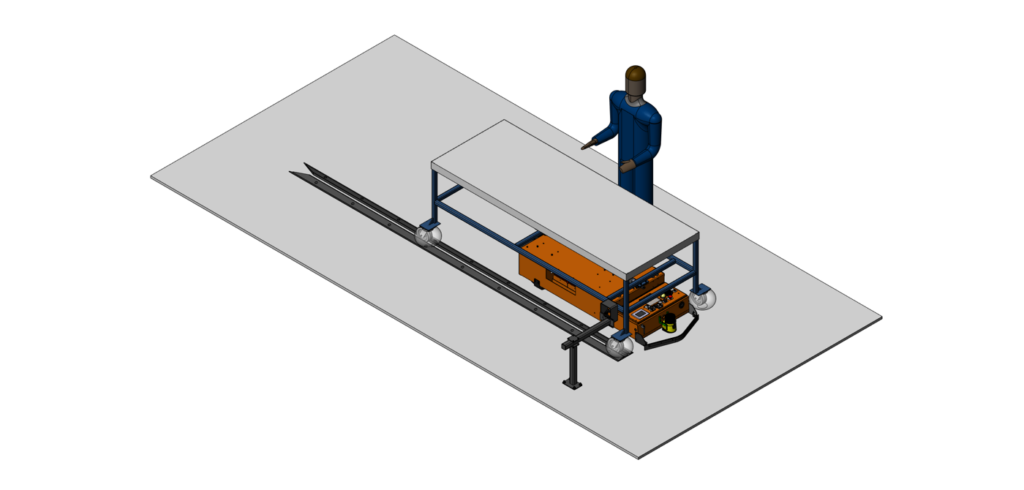
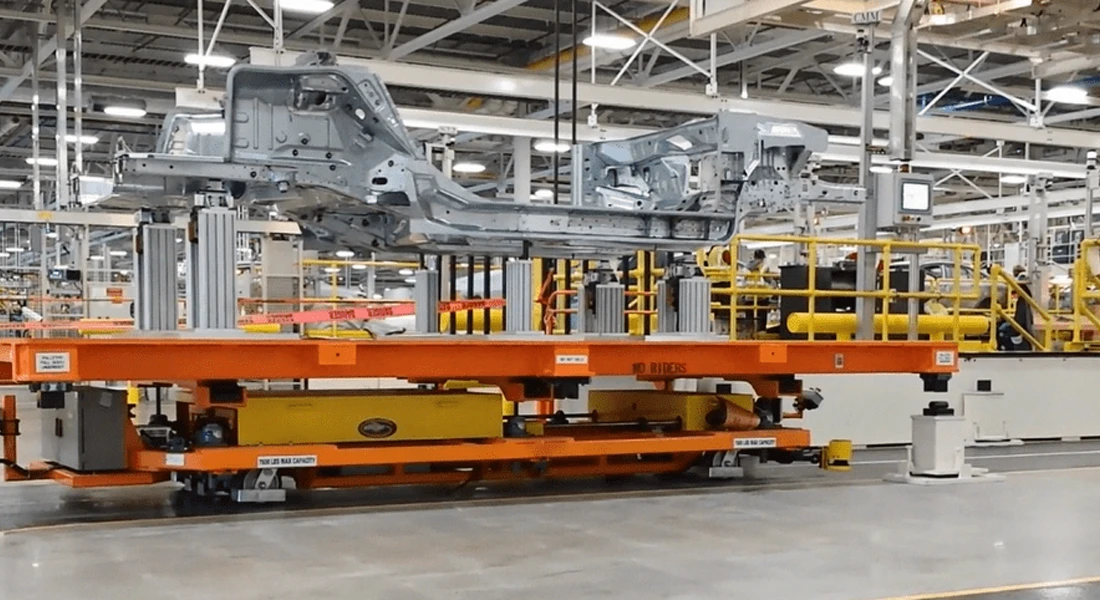
Autonomous guided vehicles range in type from lightweight ‘tugger’ AGVs that pull unpowered carts for transporting loads, to heavy-duty, high payload systems (‘unit load’ AGVs) that can transport discrete, multi-ton objects. Unit load AGVs are also increasingly being utilized to move heavy products under manufacture from one fabrication stage to another.
What Is a Unit Load AGV?
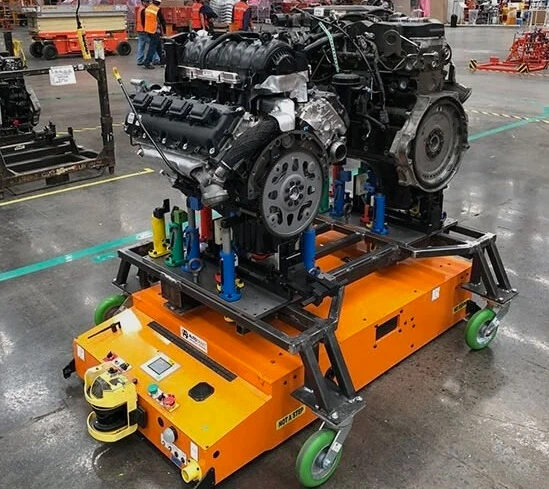
A unit load AGV (sometimes called a deck load AGV) carries a discrete load, a single product, pallet, or assembly, on its own deck rather than towing it behind. The load sits on the vehicle, which means the vehicle’s structure, drives, and brakes are sized to the full weight of whatever it carries. In heavy manufacturing, unit load AGVs do the work towlines and overhead cranes used to do: moving a product under assembly from station to station, holding position accurately enough for tooling to engage, and carrying fixtures or lift decks matched to the part. Invio Automation’s standard unit load platforms are rated to 66,000 lbs on deck or in tow, and for heavier applications the company engineers a custom vehicle around the load.
AGVs move with precisely calibrated acceleration and deceleration, and employ sensing technologies to detect people and obstacles, slowing or stopping depending on proximity and resuming when the path is clear. Some AGVs now incorporate vision systems and LiDAR, letting them navigate in a manner similar to autonomous mobile robots.
Autonomous Mobile Robots (AMRs)
Autonomous mobile robots navigate an open floor plan rather than a fixed path. They are standard equipment in warehouses and distribution centers, handling inbound putaway and outbound picking, and in manufacturing they typically deliver components, subassemblies, and kitted materials to workstations or tug lightweight carts.
AMRs navigate using LiDAR (2D or 3D) and camera systems, often both, plus other proximity sensors. They read their surroundings and choose the most efficient route to the target. If a forklift, a pallet, or a person blocks the way, an AMR maneuvers around the obstacle along the best alternative route. The distinction from an AGV is decision-making, not size: an AGV follows its assigned path, while an AMR picks its own.
Selection Criteria
Many factors go into selecting conveyance automation. The critical ones:
Capacity
In the context of manufacturing conveyance automation, capacity refers to two distinct properties:
Payload Capacity: the total weight a towline cart, AGV, or AMR can carry on board. For heavy-load manufacturing operations, where the parts and objects under assembly often exceed 10,000 lbs, high-capacity towline solutions and unit load AGVs are the established choice. The reason is less about what an autonomous platform could theoretically carry and more about control: at these weights, a product should follow a predefined, fixed path rather than leave route selection to the vehicle.
Towing Capacity: the load weight a towline conveyor, AGV, or AMR can pull behind it.
Flexibility
To respond to changing business requirements and fluctuations in demand, manufacturers are placing greater emphasis on flexible conveyance systems and moving away from solutions that rely on ‘hard’ automation and expensive, fixed infrastructure. Flexibility takes several forms:
Deployment Flexibility: the ability to deploy a conveyance system rapidly and at low cost, and to redeploy or relocate it within a site with minimal disruption. An AGV system leaves nothing permanent in the floor. If the line moves, the vehicles move with it, and a fleet that finishes one program can be reassigned to another process or another building. Manufacturers are increasingly looking to avoid projects with extensive civil work that lock in a facility layout for years to come.
Application Flexibility: the ability to repurpose a conveyance platform for different applications, processes, or operations. Most AGVs are customizable to meet specific application needs or ergonomic requirements. Common customizations include load handling carrier frames, lift decks, scissor lifts, powered trunnions, and turntables.
Scaling Flexibility: the capacity to increase or decrease the number of operational vehicles as demand shifts. With AGVs running a sequential build line, throughput can be raised or lowered by adding or removing vehicles, and for manufacturers with seasonal or hard-to-predict demand, workstations can be added or subtracted without re-engineering the line.
Safety
Safety is a key driver for increasing levels of conveyance automation. Compared with manual handling, AGVs have proven to reduce worker injury and decrease damage to parts, products, and infrastructure. They detect objects in their operational range and slow or stop to avoid them, and they carry safety edges, bumpers, and anticipatory warning lights and sounds so workers know they are approaching.
For manufacturers, safety links directly to business value: better worker retention, lower operational costs, fewer damaged products. At heavy payloads, the stakes rise with the mass involved, which is why safety analysis sits at the center of heavy-duty AGV engineering rather than arriving as an afterthought.
Efficiency, Throughput, and Uptime
Improved productivity, making more product, is usually given as the primary reason to automate. It is rarely the whole picture. A line that holds takt makes more per shift, so throughput goes up. Vehicles run every shift the same way, so uptime and OEE improve and cycle times become predictable enough to schedule around. And nobody is pushing, pulling, or craning heavy product between stations anymore, which on a heavy line is as much about keeping people safe as it is about ergonomics.
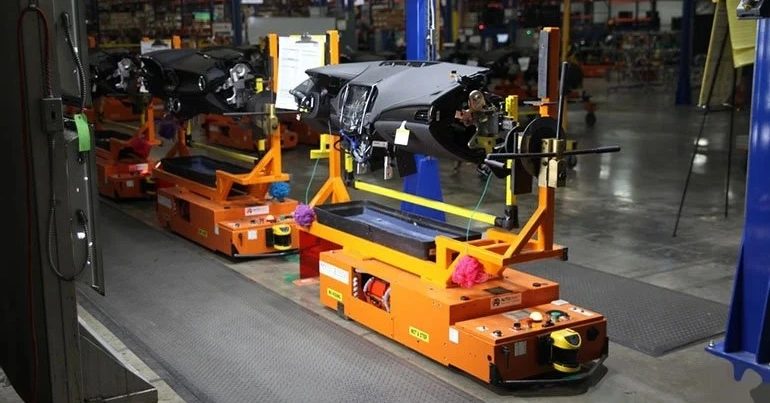
Integrating Heavy Duty AGVs With Production Systems
Conveyance solutions such as automated guided vehicles are not automation islands. In manufacturing sites, AGV fleets run under dedicated fleet management software, and that software is expected to talk to the plant’s existing systems: warehouse management, MES, and SCADA platforms such as Ignition, AVEVA (formerly Wonderware), and Plex. Invio Automation’s approach is a PLC-based fleet manager and Master Control Panel of its own design, running on commonplace Allen-Bradley or Siemens hardware, exchanging data with the customer’s production systems rather than replacing them. Fleet software responds to feedback from the production line, optimizing performance, smoothing workflows, and eliminating chokepoints.
The use of automated guided vehicles in manufacturing has been proven to increase the consistency and reliability of operations. AGVs provide dependable point-to-point transportation of goods and material, and by doing so, they sharply reduce the potential for human error, the primary source of industrial accidents and damage to products and facilities. And because AGVs are programmatically controlled and integrated with governing software systems, a vehicle can be programmed to move only when a station’s work is complete and its criteria are met, an in-station poka-yoke that keeps an unfinished job from traveling downstream and stalling the line.
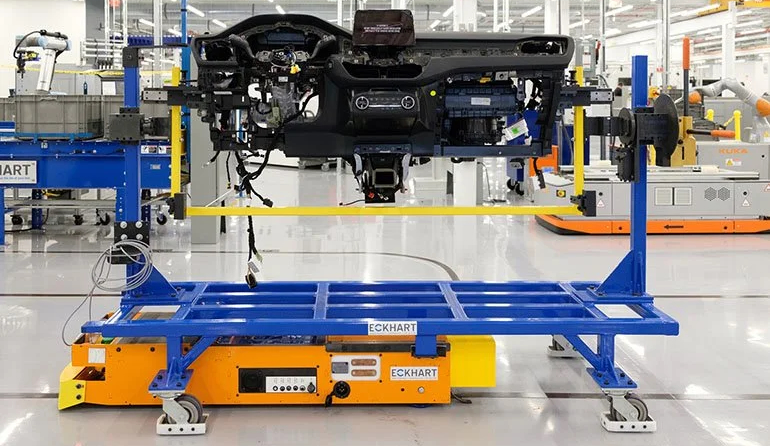
Automating Heavy Load Conveyance
For industries such as the electric vehicle, aerospace, alternative energy, and defense sectors, manufacturing processes often involve the movement of heavy parts, objects in work, and eventually, finished products. As such, the capacity of conveyance automation systems for these manufacturers must often exceed 10,000 lbs. Many manufacturers need to convey and assemble products that weigh 20,000 lbs, 30,000 lbs, and up to 50,000 lbs, but AGVs with capacity in this range are rare.
Rare, but not unavailable. Invio Automation designs and builds standard unit load platforms rated to 66,000 lbs on deck or in tow, a load Invio has moved, and custom vehicles engineered in excess of 70,000 lbs depending on the application. These are production machines, designed to hold takt on an assembly line, position accurately for tooling, and run shift after shift, rather than make occasional point-to-point moves across a yard.
The load requirements of these ‘heavy’ manufacturers set them apart from every other class of manufacturer, and they are the first thing to establish when evaluating conveyance automation.
What Makes an AGV Heavy Duty?
A 2,000 lb tugger and a 50,000 lb unit load AGV are both automated guided vehicles. They are not the same machine scaled up. For a heavy payload AGV, capacity is only one part of the engineering problem.
Invio Automation’s heavy duty AGV projects start with the manufacturing problem: the product, the process, the takt time, the stations the vehicle has to serve. The form factor comes second, sized around the load’s dimensions and how its weight sits on the deck.
The considerations below apply to any AGV, whatever it carries. As payload rises, each one gets less forgiving:
- Braking and stopping distance: Momentum scales with mass. A loaded heavy AGV needs braking systems, and stopping distances, calculated for the worst case, not the average one.
- Inertia in motion: Acceleration and deceleration curves have to move the load without shifting it, which shapes everything from motor control to how fixtures grip the part.
- Load distribution and center of gravity: Where the weight sits determines tipping risk, and a tall or asymmetric product can be harder to carry safely than a heavier flat one.
- Drive package and caster placement: Drive units, casters, and their positions are selected around the load path, so the vehicle stays planted through turns and grade changes.
- Steel structure: The frame is sized to the full rated load with an appropriate factor of safety, not adapted from a lighter platform.
- Safety and risk analysis. Every heavy duty design goes through formal risk assessment, and the safety case is built into the vehicle rather than bolted on.
None of this shows up in a catalog spec line, which is why heavy AGVs are engineered per application rather than picked off a shelf. It is also why the same base platform can end up as a lift-deck carrier in one plant and a trunnion vehicle in another.
Downtime cost calculator
What is downtime costing your production line?
Use our downtime calculator to estimate the financial impact of lost production time, and where automation changes the numbers.
Heavy Duty AGV Applications
Heavy duty AGVs are typically found where a large product or assembly has to move through a repeatable manufacturing process, rather than from one storage location to another. Common applications include:
- Automotive and electric vehicles: moving bodies, chassis, and large battery assemblies between build stations.
- Agricultural and construction equipment: carrying tractors, machinery frames, and other high-mass assemblies through progressive production.
- Aerospace and spaceflight: moving large structures between fabrication, integration, and inspection stages.
- Energy: transporting large components for alternative energy and industrial equipment manufacturing.
- Mining equipment: haul truck frames, powertrain modules, and other oversized fabrications, much of it for the same OEMs that build agricultural and construction machinery.
- Data center infrastructure: battery energy storage modules, backup generators, switchgear, and cooling units moving through fabrication and integration. Battery storage is the heavy end; switch and cooling stations usually come in under 15,000 lbs.
In every case, the vehicle is engineered around the product: its weight distribution, the takt time required, and how the load has to interface with each workstation.
AGVs Vs Towlines
High payload AGVs and towlines share one ability: moving heavy items sequentially along a manufacturing workline. The similarities essentially end there.
AGVs deploy without the cost of building fixed towline infrastructure, including the trenching required to embed the towline itself. No civil work, no floor cut open, no layout locked in. Production lines can be installed quickly and modified to match a changing assembly process, which is why manufacturers replacing an aging towline or skillet system increasingly specify unit load AGVs to run the same line shape the chain used to pull.
Towlines have drawbacks beyond the civil work. The recessed chain and floor slot are a trip and entrapment hazard where people work alongside moving carts, and a cart on a continuous chain cannot sense a person or an obstacle ahead of it. The slot collects debris, coolant, and swarf, so it needs regular cleaning and the chain needs maintenance. And since every cart hangs off the same chain, one failure stops the whole line. An AGV fleet fails one vehicle at a time, and the line keeps moving around it.
There is one thing a towline still does well: it is mechanically simple, and for a line that will never change, that simplicity has value. The moment the line needs to flex, the trench becomes a liability.
AGVs vs AMRs
Automated guided vehicles and autonomous mobile robots both beat towlines on flexibility and safety, and both scale by adding or removing vehicles. The difference between them is navigation, not size. An AGV follows a predefined path, guided by tape, markers, or plant features. An AMR reads its surroundings and picks its own route.
For heavy load manufacturing, that difference decides the question. A product weighing 20,000 lbs or more should travel a fixed, predictable path, one that people on the floor can see and anticipate, rather than leave routing decisions to the vehicle. The heavier the payload, the stronger the case for determinism. This is a safety argument, not a capability ceiling, and it is why heavy production lines are built on AGVs while AMRs excel at the work around them: lineside replenishment, kitting delivery, and cart tugging, where dynamic routing is exactly what you want.
For a full breakdown of how the two compare across navigation, infrastructure, fleet software, and cost, see our article detailing AGVs vs AMRs.
AGVs vs Rail-Guided Vehicles (RGVs)
In aerospace and other very-heavy sectors, the shortlist sometimes includes rail-guided vehicles (RGVs), which run on fixed steel rails set into or onto the floor. Rails carry weight well, and for a single unchanging route they are a good answer. But they share the towline’s weakness: the route is the infrastructure. Extending or rerouting an RGV line means steelwork and floor modification, and the rails themselves become an obstacle for everything else moving through the plant. A heavy duty AGV carries comparable loads on a flat floor, follows a path that can be redrawn without construction, and leaves the floor clear when it isn’t there. For heavy products that will outlive several plant layouts, the flat floor usually wins.
What Does an AGV Manufacturer Need to Specify a Heavy Load System?
Before a heavy duty AGV can be specified, the engineering team needs more than a payload weight. The key inputs: the load’s dimensions and center of gravity, the takt time, the workstation interfaces, floor conditions, required positioning accuracy, the navigation method, and how the vehicle needs to exchange data with the production line.
For high-payload applications, the product and the manufacturing process come first. The vehicle’s dimensions, drive package, structure, and safety systems are engineered around them.
Best of Both Worlds
Manufacturers are increasingly turning to automation and robotics to meet the challenges of rapid business change, sector growth, and increased competition. That includes manufacturers in medical devices (think MRIs), commercial trucks, spaceflight, recreational vehicles, and other heavy industries, and it spans the sectors where large parts and heavy assemblies are the daily reality: automotive, agriculture and construction equipment, aerospace, energy, mining, and data center infrastructure.
In the past, these manufacturers automated their production lines with towline systems. Towlines move heavy loads dependably, but they lack the flexibility built into modern conveyance, and their infrastructure outlives its usefulness the first time the line changes.
Autonomous mobile robots brought deployment, application, and scaling flexibility to the plant floor, and they have earned their place in lineside work. Heavy production lines, though, run on determinism: a fixed, visible path for a product that can weigh as much as a loaded truck.
The business case follows the same shape. A typical system reaches ROI in 2 to 3 years, depending heavily on project scope, and the value comes less from the vehicle than from what it removes and enables: manual handling and forklift traffic out, takt and throughput gains in. AGVs only move things. The return comes from the process changes that movement makes possible.
Modern heavy duty AGVs combine the flexibility, safety, and scalability of autonomous mobile robots with the load capacity of towline conveyors. Invio Automation designs and builds them in Michigan: standard unit load platforms rated to 66,000 lbs on deck or in tow, custom vehicles engineered for heavier applications, and every vehicle designed and validated to ANSI/ITSDF B56.5, RIA R15.08, ISO 3691-4, and UL 508A.
For production build lines designed for manufacturing as it is done today, and for the demands of tomorrow, that is the best of both worlds.
Heavy duty AGVs
Moving something heavy?
Tell us the product, the weight, and the takt time. Our engineers will tell you what the vehicle needs to be.
About the Author
Kyle Genshow is a Business Unit Manager at Invio Automation with nearly 20 years of experience in the automation industry. Throughout his career, he has played a key role in developing Invio’s automated guided vehicle (AGV) capabilities and supporting complex AGV projects for customers. His experience includes launching large-scale automation projects integrating semi-automated and automated tooling with AGV systems into complete, harmonized solutions. With experience across a diverse range of end markets, Kyle brings a strong understanding of how automated material movement solutions can be effectively applied to real-world manufacturing environments.