
Industries
Medical Device & Life Sciences Automation
Invio Automation is a medical device automation company. We design and build custom assembly, inspection and test systems for medical device and life sciences manufacturers, and we support you through validation, and keep your line running afterwards with spare parts, service and upgrades.
What We Do
Medical Device Automation Systems, Engineered Around Your Device
Medical device automation uses custom-engineered equipment, including robotics, precision feeding, joining, machine vision and test stations, to assemble, inspect and verify medical devices with consistent quality and documented traceability. For manufacturers in regulated markets, it replaces variable manual steps with repeatable, validated processes that hold up to audit and scale with demand.
Your device and manufacturing process come first. We’re an engineering partner, not just a systems integrator: we design, build and test turnkey automation systems in-house, specifically for medical device and life sciences manufacturing. One team takes your project from concept and process development through factory acceptance testing (FAT) at our facility, installation and site acceptance testing (SAT) at yours, validation support, and service for the life of the system. We don’t sell a catalog machine and ask you to change your process to fit it. The system is engineered around your device.

That approach scales from a single semi-automated cell for clinical builds to fully automated, high-volume production lines, and from standalone process stations to connected, smart factory systems that exchange production and traceability data with your existing MES. The same engineering discipline applies across drug delivery devices, diagnostics, catheters, needles and sutures, and every application below.
Medical Device Automation Applications
Our medical device experience spans a wide range of applications, with seven areas where we’ve built deep manufacturing automation expertise. Each brings its own feeding, joining and inspection challenges, and we’ve solved them on production floors.

Drug Delivery Devices
Autoinjectors, pen injectors, dry powder inhalers and on-body pumps, from component pre-assembly through final assembly and functional test.
Quality is verified throughout assembly with press force and displacement monitoring, pull, leak and occlusion testing, so defects are caught before the device is closed.


Diagnostics & Point-of-Care Devices
Test bases, cartridges, microfluidic chips and reagent packs for point-of-care and laboratory diagnostics. We integrate the processes these products need, from high-precision reagent dispensing and laser or ultrasonic welding to vision-guided assembly, leak and occlusion testing, and laser, inkjet or pad-printed identification for traceability.

Catheters, Tubing & Fluid Management
Catheter assembly from post-extrusion operations through finished device: cut to length, core pulling, tipping and forming, flaring, thermal and adhesive bonding, balloon catheter winding, and bonding catheters to devices. Inline vision inspection and functional testing cover leak, flow, occlusion and lumen crosstalk.

Needles, Cannulas & Sutures
Needle bending and forming using our patented bending technology, plus small medical tubing and blade bending, cannula bonding, and suture forming and winding. These parts are small, sharp and unforgiving of misalignment, so part handling and vision guidance drive most of the design.
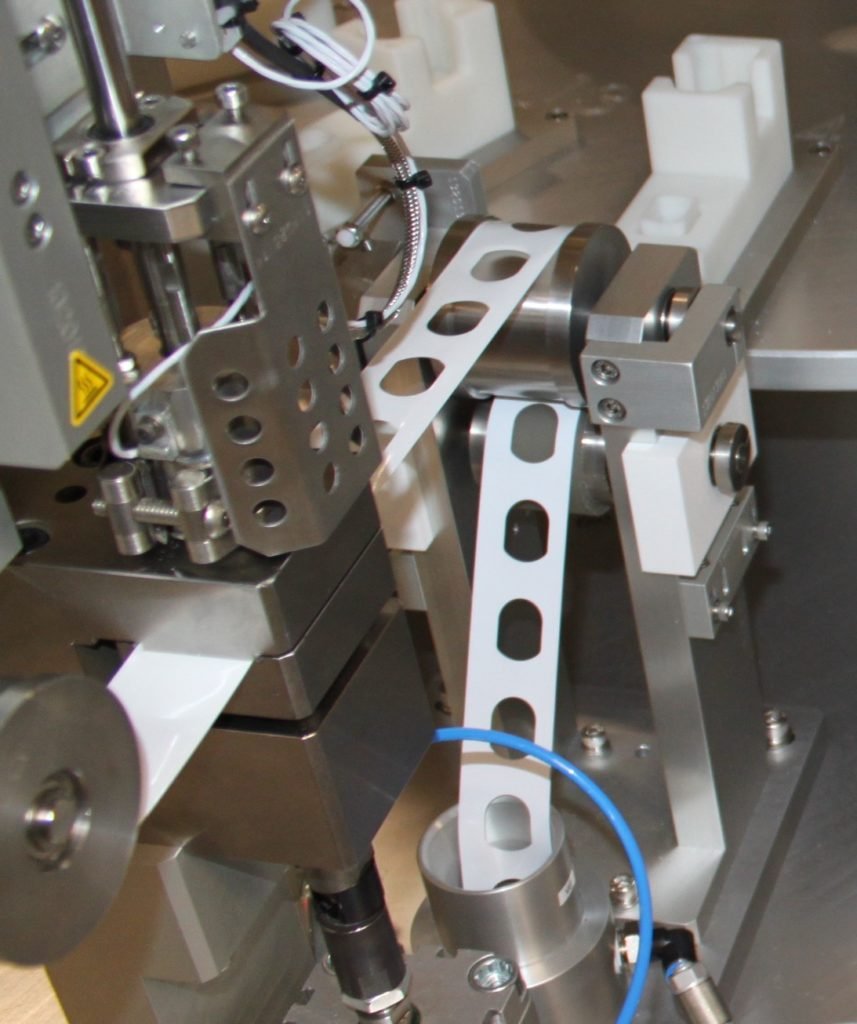

Drug Delivery Device Automation
We build the factory automation that produces drug delivery devices: assembly, inspection and test systems for autoinjectors, pen injectors, inhalers and wearable insulin delivery systems. The hard part is rarely the final snap-fit. It’s spring handling, needle protection, and proving that every unit leaving the line was assembled correctly.
Autoinjector and Pen Injector Assembly
GLP-1 demand has pushed many autoinjector and pen injector programs from clinical lots toward commercial volumes faster than their manufacturing plans expected. We’ve delivered autoinjector and pen injector assembly systems for development and validation builds, typically around 15 parts per minute, where process control matters more than speed. Spring handling, needle protection, and force and displacement monitoring at every press stage are engineered in from the first machine, so the process you validate is the process you scale.
Feeding is matched to part geometry, bowl or flexible, and zero-point tooling keeps changeovers fast. Two or three device variants can often share a single nest or pallet, and every unit is functionally tested before release.
Inhaler Assembly
One drug delivery inhaler system we built assembles nine components at around 15 parts per minute. The difficult step was feeding multiple springs reliably. Servo presses at key stations record a force-versus-distance signature for every unit, and any signature outside its window rejects the part, catching missing or doubled components that can’t be seen once the device is closed. That system stayed in production for 26 years.
26
years in production for one Invio-built inhaler assembly system
From Clinical Builds to Full Production
Most of the risk in a medical automation program sits in the handoffs: from your device design to our machine design, from clinical lots to commercial volume, from factory acceptance to your validation.
We plan for those transitions from the beginning, working with your team to understand current production requirements, forecasted demand, and the milestones that will drive future capacity. Together, we can develop an equipment roadmap that matches automation investment to the expected growth of the product. That may mean designing the first machine with provisions for additional capacity, creating a repeatable platform that can be duplicated as demand increases, or developing a tiered automation strategy where each stage of production is supported by the right equipment, from flexible semi-automated systems producing a few parts per minute to highly automated, data-integrated production lines operating at hundreds of parts per minute.
The goal is not simply to design equipment for today’s volume, but to establish a manufacturing strategy that can evolve with the product and provide a clear path to commercial scale.
1
Concept and Process Development
We engage with your product and process engineers while there is still flexibility to influence the device and manufacturing process. Through design-for-manufacturability and design-for-automation reviews, we help identify opportunities to make components easier to feed, locate, assemble, join, inspect, and test.
Recommendations may include adjustments to part geometry and tolerances, datum and fixturing features, assembly sequence, materials, or joining methods that can simplify equipment and improve manufacturability as production ramps. We support those decisions with proof-of-principle testing, 3D simulation, and a user requirements specification (URS) developed collaboratively with your team.
The goal is to resolve manufacturing challenges while they can still be addressed in the product or process, rather than designing unnecessary complexity into the automation.
2
Clinical and Pilot Builds
For clinical lots and early production, full automation is not always the right investment. When production rates are only a few parts per minute, operators can efficiently manage material flow, part loading, unloading, and transfers while semi-automated equipment performs the critical assembly, joining, dispensing, inspection, or testing processes. This allows automation investment to focus where it provides the greatest value: repeatability, process control, quality, and data collection.
Where possible, these systems incorporate the same fundamental processes that will ultimately be used for commercial production, creating a natural path toward higher levels of automation as demand increases. Every system goes through factory acceptance testing (FAT) at our facility before it ships and site acceptance testing (SAT) after installation, and we can also support installation and operational qualification (IQ/OQ) on site.
3
Commercial Scale
When volumes ramp, the roadmap set at concept stage comes into play. Depending on the plan, that means adding stations or multi-up tooling to the existing system, duplicating a proven platform, or moving to a high-volume line built on the same core process steps, so revalidation stays focused on what has changed.
Speed matters at this stage. For one point-of-care diagnostics customer, we delivered a production system in half the usual 52-week lead time.
4
Support for the Life of the System
The value of an automation investment is realized over years of production, not just at launch. Spare parts programs, preventative maintenance, responsive service, obsolescence management, and upgrades and retrofits keep equipment performing for the life of the product, protecting your return and avoiding premature replacement. Medical systems we’ve built have remained in production for decades.
What We Do
Medical Device Assembly Capabilities, Station by Station
Every system we build follows the same path a part takes through the line. This is the medical automation equipment we engineer at each stage.
STAGE 1
Feeding, Handling and Orientation
Small, fragile, flexible, sharp, or difficult-to-orient components can present unique automation challenges that require careful consideration of how each part is presented, separated, handled, located, and assembled. We evaluate those challenges early, developing handling and fixturing strategies alongside the assembly process to create a robust solution without introducing unnecessary complexity.
- Part feeding and orienting, including flexible feeding for mixed parts
- Sensitive product handling for fragile, coated and sterile-path components
- Tray loading and unloading
- Mold and machine tending
- Industrial robots and cobots
- Web, film and membrane handling
- AGV and AMR material delivery between cells
STAGE 2
Assembly, Joining and Forming
- Precision assembly and servo presses with force profile monitoring
- Ultrasonic welding
- Laser welding
- RF welding
- Thermal staking and thermal bonding (contact and noncontact)
- Resistance welding
- UV- and thermal-cure adhesives with precision and high-viscosity dispensing
- Fastener assembly
- Needle, small medical tubing and blade bending (patented technology)
- Catheter tipping and forming, including RF and induction tipping
- Die cutting and impulse bag sealing
STAGE 3
Inspection and Test
We put inspection at the station where a fault can happen, not only at the end of the line, so a bad part is rejected before more value is added to it. We’ve solved some demanding optical inspections, including clear-on-clear part inspection, where standard vision setups struggle.
- 2D vision, 3D vision and laser inspection
- Force and displacement signature monitoring
- Leak & occlusion testing
- Flow testing
- Electrical and functional testing
- Bluetooth testing for connected devices
STAGE 4
Marking, Data and Traceability
Every unit can carry its own manufacturing history: component lots, the stations that built it, critical process parameters and every test result, shared with your MES for end-to-end traceability. The payoff comes when something goes wrong. Instead of evaluating months of production, your team can contain only the units actually affected.
- Laser and inkjet marking, pad printing and hot stamping
- High-speed, precision label print and apply
- RFID and 2D Barcode serialized traceability
- Per-unit data collection and analytics
- Local data capture and storage
- Database implementation
- MES integration
ACROSS THE LINE
Controls and Integration
Controls are designed alongside the mechanics, not added at the end, and built to your plant standards for PLC platform, HMI style and network architecture.
- Controls engineering, including PLC programming and HMI development
- Electrical panel design and build
- Machine safety design and risk assessment
- Recipe management and user access controls supporting 21 CFR Part 11
- Robot, vision and laser integration
- Vision-guided servo control
- Data exchange with MES and plant systems
Validation, Compliance and Cleanroom Design
Your validation team will live with a system’s documentation for longer than our engineers live with the machine, so we write it for them.
Quality System and GAMP 5
Every Invio site operates under an ISO 9001 certified quality system. We design and document every medical system using a Good Automated Manufacturing Practice (GAMP 5) risk-based approach, from the user requirements specification (URS) through design specifications, risk assessments and test protocols.
Acceptance Testing and Qualification
Every system goes through factory acceptance testing (FAT) at our facility before it ships. Once your team has installed it in your room, we can support utility connections, then run site acceptance testing (SAT) to confirm the system matches its FAT performance. We support installation qualification and operational qualification (IQ/OQ) and computer system validation. Performance qualification (PQ) is carried out by your team, on your product, in your facility.
Electronic Records
Our systems support 21 CFR Part 11 for the electronic records they generate. Long-term record storage and retention sit within your own quality systems.
Cleanroom Design
We design for ISO Class 8 and Class 7 cleanrooms as standard, and we’ve built systems for ISO Class 5 environments where the process demands it. Materials, finishes and layouts are chosen for cleanability from the first concept.
PLATFORMS
Proven Platforms, Configured Around Your Device
Engineered to order doesn’t mean starting from a blank sheet. Most of our medical systems are built on platforms and engineering libraries already proven in production, then configured around your device. That cuts lead time and risk without forcing your process onto a standard machine.
Excel Assembly Platform
A standard machine base with custom process stations, refined over many medical builds. The base is proven. The stations are engineered for your device.
Patented Needle and Tube Bending
Our patented bending technology forms needles, small-diameter medical tubing in metals such as 316L stainless steel, and blades. We’ve supplied it in several configurations for different part geometries.
Smooth Inner Bore (SIB) Polymer Tube Joining
Our SIB equipment joins polymer tubing without leaving a ridge inside. The tube ends are heated and joined while an internal bladder expands to support them, so no material protrudes into the inner diameter. That matters wherever fluid or another component has to pass cleanly through the joint.
This is especially important in clean-in-place (CIP) process systems, where the internal flow path needs to minimize crevices, steps, and potential hold-up points. Creating a smooth, continuous internal surface helps prevent biologics, reagents, and process chemistries from becoming trapped within the equipment plumbing, supporting more effective cleaning, reducing the risk of product carryover, and helping maintain a controlled process environment between production runs.
DAQ Data Acquisition System
A standard data acquisition system for life sciences production and test, purchased repeatedly by a global life sciences supplier.


Speak to an Application Engineer today.
Connect with an Invio engineer at any point in your project process. We can quickly provide pricing and technical guidance to help accelerate your medical device application exploration or provide actionable proposals if your requirements are known.
Medical Device Automation – Frequently Asked Questions
Gallery
Vial handling
Medical device assembly