Most plants approaching their first mobile automation project ask the same question: AGVs or AMRs?
It feels like the decision, but it is increasingly the wrong place to start, because the industry itself is erasing the line between the two. The more useful question is not which label wins, but how the whole system is designed around the work, because production flow, integration, safety, and controls matter far more than the acronym on the vehicle.
The applicable standards that govern their safety, ISO 3691-4 internationally, with B56.5 & ANSI/RIA R15.08 in North America, treat automated guided vehicles and autonomous mobile robots as a single family of “driverless industrial trucks.” Fleet software now coordinates both side by side, and MHI groups its member companies under the neutral label Mobile Automation Group rather than splitting AGV from AMR.
We write this from an AGV-centric vantage point. Our core work is industrial manufacturing and assembly, where custom, high-capacity guided vehicles are replacing the traditional production conveyance (skillet systems, overhead power-and-free carriers, in-floor chain) that has moved product down assembly lines for decades. Our own heavy AGVs now use vision and LiDAR to navigate with a flexibility once reserved for AMRs, adding that adaptability on top of the precision and repeatability that guided vehicles have long brought to heavy, exacting work.
The honest framing is a spectrum of navigation, payload, and autonomy, not a binary. The choice is also becoming more reversible: the VDA 5050 interoperability standard, released in version 3.0 in March 2026, lets one fleet manager orchestrate mixed-brand AGV and AMR fleets, which lowers the stakes of committing to either label up front.
The market backdrop reinforces the point. Interact Analysis projects mobile robot revenue rising from just under $5 billion in 2024 to roughly $14 billion in 2030, an average of about 19% a year, far outpacing the 2.4% expected for fixed automation, even after the firm trimmed its forecast amid global trade and tariff uncertainty.
Both technologies are growing within that total. AMR unit volume is climbing fastest in lighter, high-variability applications, while AGVs continue to hold the heavy-payload, high-precision, and takt-critical work where cost certainty, reliability, and safety decide the outcome.
So the real decision is not which acronym wins. It’s which point on the navigation and autonomy spectrum fits your payload, takt time, route stability, safety case, and integration needs, and how the surrounding system is engineered. For stable, heavy, high-precision work, that logic often still points to an AGV; for fluid, fast-changing flow, to an AMR. Either way, the label should follow the system design, not lead it. In heavy manufacturing, especially, that system is where projects are won or lost. This guide is a practical framework for making the call.
What Is an AGV?
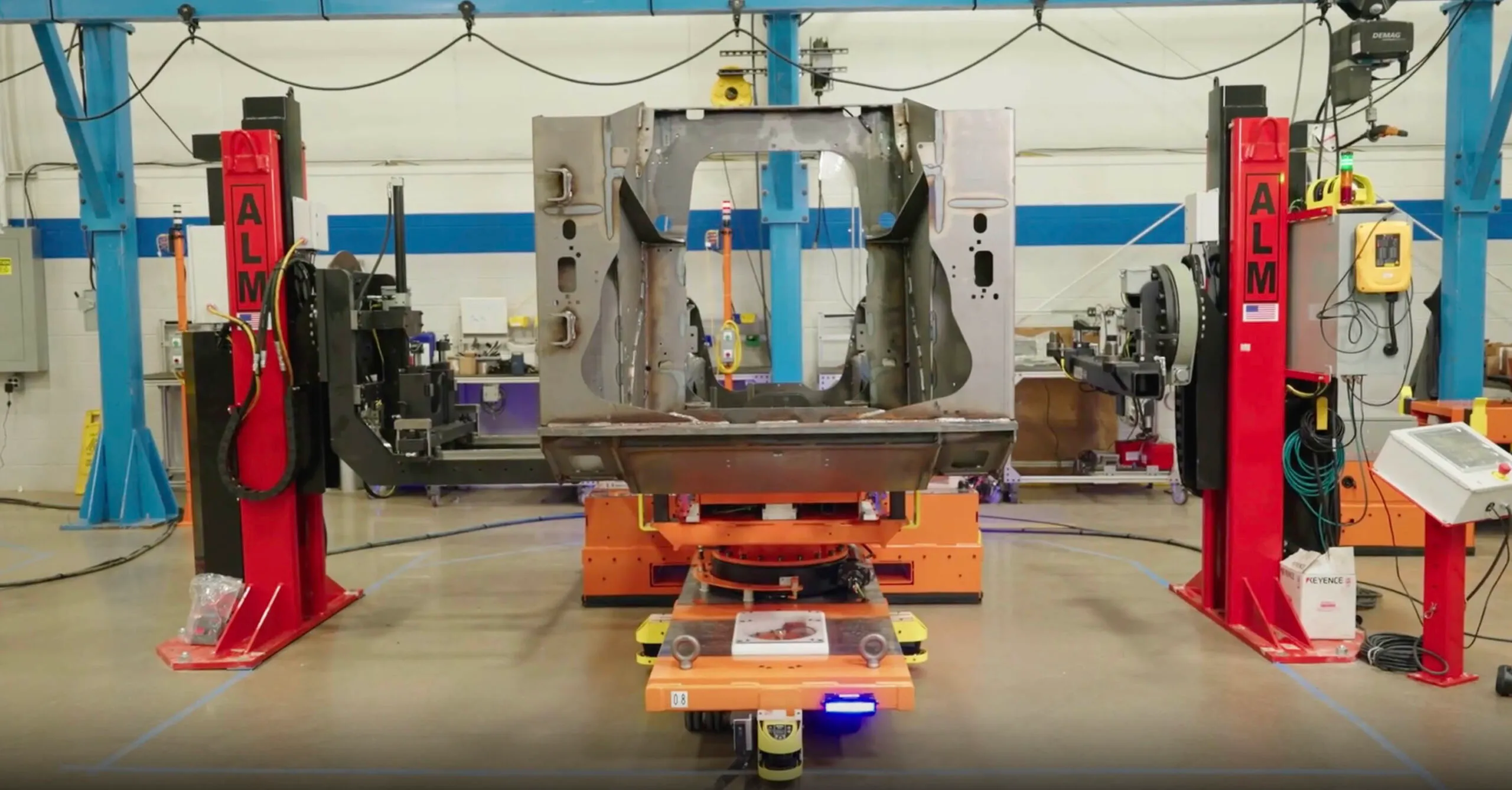
An automated guided vehicle moves material along defined routes. Historically, that meant physical guidance such as wires, magnetic tape or floor markings. Today, many AGVs add programmed virtual paths, and a growing number use vision systems and LiDAR to navigate with far more autonomy than the “follows a fixed line” stereotype suggests. What stays constant is control: an AGV is engineered to repeat a known route precisely, shift after shift.
That precision is why AGVs anchor heavy industry. They range from tugger AGVs that pull unpowered carts to unit-load vehicles that carry multi-ton objects between fabrication stages, handling payloads far beyond what people or forklifts can manage. Invio AGVs have supported loads up to 70,000 lbs in production.
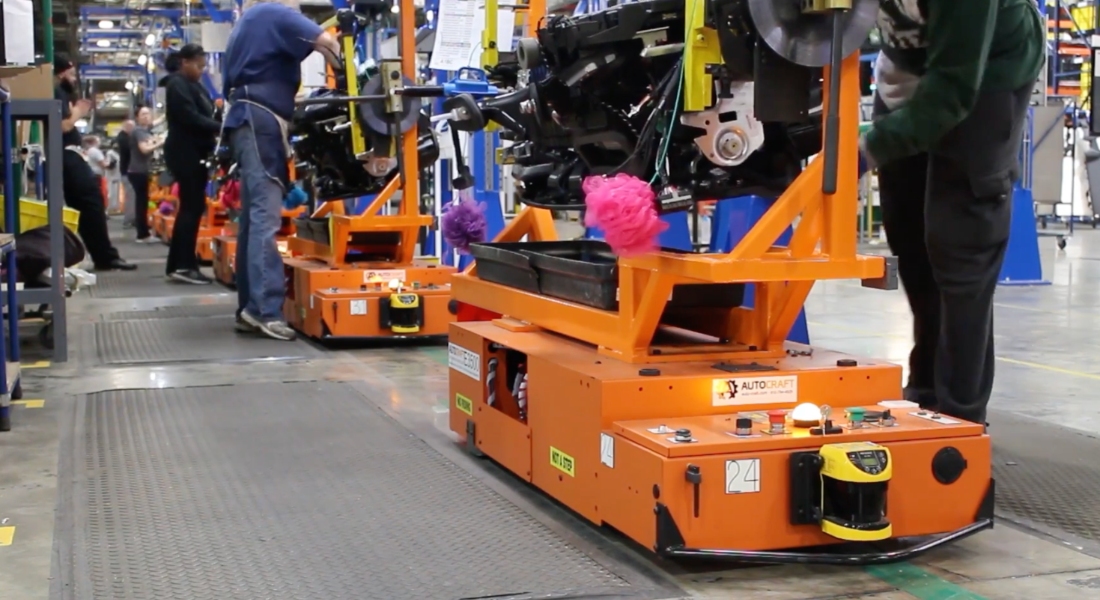
Beyond transport, an AGV often doubles as a moving assembly platform, and increasingly as the modern replacement for dedicated fixed conveyance that routinely outlives both the product and the process thinking it was built around. An AGV line carries none of that fixed-asset weight. When the product or the process changes, the same vehicles can be retooled, reprogrammed, scaled or redeployed to build something else entirely, in the same facility or another one, at a fraction of the cost of the tear-up and rebuild that traditional conveyance demands.
An AGV carries a product through sequential stations while operators and robots work on it, coordinated with line-side tooling such as lift assists and torque arms. Safety is engineered into that motion rather than left to judgment: operating speeds are programmed for each stage of the route instead of relying on a driver’s discretion, and strategically placed safety scanners protect the people working on and around the product as it moves through the process.
Far from obsolete, autonomous guided vehicles remain the most efficient answer when the process is stable, the load is heavy, and positioning must be repeatable and exact.
What Is an AMR?
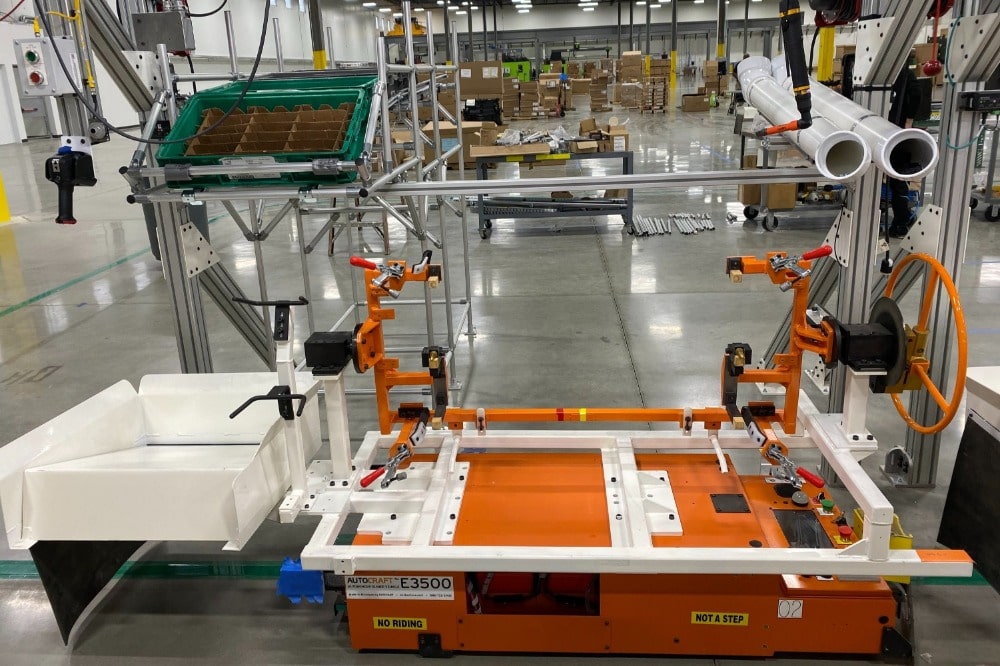
An autonomous mobile robot decides how to move. Using onboard sensors, maps and path-planning software, it navigates in real time and reroutes around a pallet, a person or a parked forklift without stopping the line.
In practice, AMRs are frequently kept to virtual lanes or corridors so traffic stays predictable, which means “free roaming” is more controlled than the marketing implies. The defining trait is adaptability: the vehicle adjusts in real time to a facility in a constant state of change.
Lightweight, warehouse-style AMRs dominate the headlines, but the category is not limited to small loads. Heavy-duty autonomous mobile robots carry sub-assemblies, work-in-progress, and finished goods through highly automated, operator-heavy processes, the kind of heavyweight assembly environment we build for.
As with AGVs, the vehicle is only part of the story. An AMR’s real capability comes from its PC-based controls, fleet management software, and the tooling and load interfaces it carries, all of which make it one connected element of a larger system.
AGV vs AMR: The Practical Differences
Navigation remains the clearest divide: an AGV follows a route engineered to be predictable and repeatable, while an AMR follows a prescribed route but plans its own obstacle avoidance and recovery path, trading some predictability for adaptability. That one difference ripples into deployment time, operator safety and starting cost.
Two points deserve emphasis. Payload is not a dividing line: heavy-duty AMRs exist, but moving large assemblies safely demands engineering of stability, stopping distance, floor condition, and tooling regardless of the badge.
And cost is a system measurement, not a sticker price; the cheapest vehicle rarely produces the lowest total cost once infrastructure, integration, rerouting, maintenance, and downtime are counted. The table below works as a first-pass scorecard: read each row against your own application, and the right starting point usually reveals itself.
| Dimension | AGV | AMR |
| Primary use case | Production: assembly conveyance and heavy, repeatable moves through the build | Material logistics: line-side delivery, replenishment, pallet and cart movement, warehousing |
| Navigation | Defined guidance (tape, magnets, programmed routes), increasingly with vision or LiDAR options | Sensor mapping and onboard path planning; often kept to virtual lanes for traffic control |
| Obstacle avoidance | Slows or stops on detection; limited rerouting | Reroutes dynamically around obstacles |
| Payload | Engineered for heavy, multi-ton work; Invio AGVs support up to 70,000 lb | Typically lighter (up to 2,000 lb); heavy-duty AMRs exist but demand the same stability and safety engineering |
| Positioning precision | Repeatable, exact docking for robotic and fixtured work | Capable, but dynamic paths make exact repeatability harder to guarantee |
| Takt time and throughput | Deterministic cycles hold takt and hourly output shift after shift | Throughput can vary as vehicles adjust to conditions |
| Customization | Often custom-engineered around the product and assembly process, including fixturing | Largely standard platforms configured with options and top modules |
| Tooling and controls integration | Deep integration with PLCs, SCADA, MES, line-side tooling and automation stations | Integrates through fleet software and APIs on PC-based controls |
| Safety | ISO 3691-4 / ANSI B56.5; deterministic zones simplify the risk assessment | ISO 3691-4 / ANSI R15.08; dynamic paths require careful, repeated risk assessment |
| Deployment / installation | May need floor guidance; reconfiguration is a controlled engineering change | Map-and-go; faster to reconfigure |
| Flexibility and scalability | Retooled, reprogrammed or redeployed as products and facilities change; scales by adding vehicles | Adapts to changing layouts and delivery points; scales by adding vehicles |
| Maintenance skill set | Traditional PLC and controls background, common in plant maintenance teams | PC-based controls and software; IT-leaning skills that are scarcer on the factory floor |
| Maintenance / reliability | Fewer software variables; predictable wear on fixed routes | More sensors and software to maintain; relies on fleet health monitoring |
| Cost / TCO | Higher fixed infrastructure; wins in stable, heavy, high-volume lanes | Lower infrastructure, higher software cost; wins where layouts change |
When an AGV Makes More Sense
An AGV grows more compelling the more stable an operation is. When a route is fixed and the same load travels the same path thousands of times, predictability becomes an asset rather than a constraint.
Operations built around a defined production sequence, or replacing a manual tugger or forklift run with a controlled automated process, are usually better served by a guided vehicle than by autonomy they will never exercise.
There is a staffing reality behind that, too. AGV maintenance draws on the traditional PLC-based controls background, digital, and analog, that most plant maintenance teams already hold, while PC-based platforms lean on an IT-trained skill set that is far less prevalent on the factory floor.
For heavy manufacturing, a guided vehicle is usually the default starting point, and the reasons are the ones that dominate a heavy-load line: cost, reliability, and safety. A fixed, well-understood route is cheaper to run and maintain across years of high-volume production, its deterministic motion is dependable shift after shift, and its predictable behavior is easier to certify around heavy loads and tight takt.
When a multi-ton assembly must arrive in the same place, the same way, every cycle, that repeatability is the requirement, not a bonus. From there, the engineering effort shifts to the cart, fixturing, controls, and safety architecture around the vehicle, which is where a heavy-line project is ultimately won or lost.
When an AMR Makes More Sense
AMRs earn their place wherever change is the norm rather than the exception. When layouts are reconfigured regularly, delivery points vary by product mix, or operators, forklifts, and temporary obstacles share the floor, rerouting on the fly turns into real operational value.
The applications sit in the outer layer of material logistics: point-of-use delivery of components to the line side, AMR-driven supermarkets that replenish inventory on demand, pallet and cart movement between storage and production, and logistics and fulfillment workflows such as dock-to-stock and cross-docking.
The deciding factor is whether that flexibility creates value. If a route never changes, the added autonomy and software complexity may not pay for itself; if delivery points, layouts and product mix shift constantly, the same flexibility becomes a strategic advantage rather than a line on a spec sheet.
Heavy Manufacturing: Where the Decision Gets Made
Most “AGV vs AMR” advice is written for warehouses and e-commerce fulfillment, where loads are light, and the goal is picking throughput. Heavy manufacturing is a different problem, and it is where the decision actually gets made. It is also where AGVs most often come into their own.
When the payload is a vehicle body, an aircraft structure, a wind-turbine component, a battery module or a piece of medical imaging equipment, the criteria that flip the choice are payload and stability, docking and positioning precision, fixturing coordinated with the MES, and takt time, not navigation style alone.
Invio’s heavy AGV work spans vehicle assembly across passenger, commercial, and EV platforms, agriculture and construction equipment, aerospace and heavy transportation, energy systems from wind turbines to whole-home generators, battery cell and module manufacturing, and medical imaging production. Each demands a vehicle engineered for high mass and precise positioning, integrated with line-side tooling and coordinated through a PLC-controlled fleet manager and SCADA.
A few patterns recur. Where a large weldment or chassis must reach a station in an exact orientation for robotic work, or where the vehicle itself carries the product through direct assembly, the deterministic positioning of an AGV usually wins; AMRs rarely fit direct assembly applications. Where sub-assemblies and work-in-progress move through an operator-heavy process whose layout shifts with the product mix, a heavy-duty AMR’s adaptability earns its place. In many plants, the honest answer is both, which is why the engineering around the vehicle, the fixtures, the controls, and the safety zones matter more than the label on it.
The Real Cost: TCO and Simulation
Reading the Current Operation
Capital follows a credible business case, and the case starts with an honest read of today’s operation: the labor spent moving material, the forklift traffic and the safety incidents that come with it, the stalls when parts arrive late, the work-in-progress stacked at congested line-side points, the changeover frequency, the downtime traced to inconsistent flow, and the product mix and expansion plans ahead.
Total Cost of Ownership
Then comes total cost of ownership, where the vehicle price is the smallest part. Published industry estimates put standard catalog AMRs roughly in the $25,000 to $150,000 range and catalog AGVs from about $15,000 to $80,000, with fixed AGV floor infrastructure adding tens of thousands more for a large facility; rerouting a hard-guided AGV can cost several thousand dollars, while an AMR reroutes in software.
Engineered custom AGV systems are a different bracket altogether: they typically range from $35,000 to $350,000 per vehicle plus infrastructure, with the cost dominated by integration, fixturing and controls rather than the vehicle itself.
The durable conclusion across studies is simple: over a typical multi-year horizon, AMRs tend to win where layouts change, while AGVs win in stable, long-lived, heavy, high-volume lanes. The decision hinges on volatility, which is exactly why production flow comes before vehicle choice.
Downtime cost calculator
What does an hour of downtime cost you?
Put a real figure on unplanned stops with Invio’s downtime cost calculator, the number your business case starts from.
Simulation as a De-Risking Tool
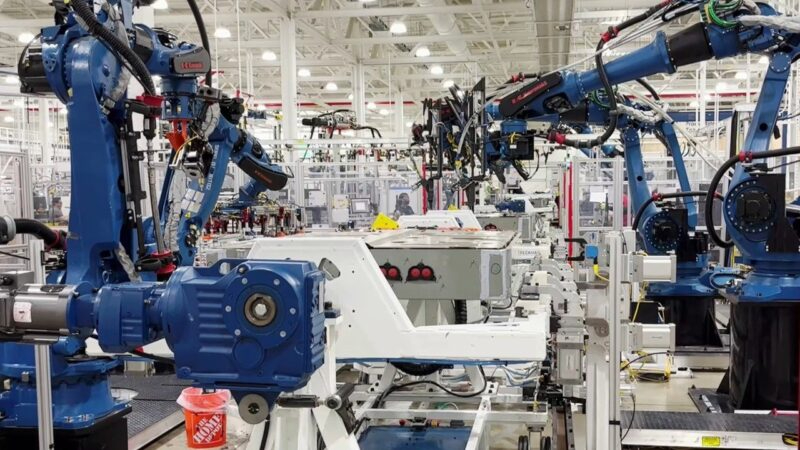
The way to de-risk the spend is through simulation. Discrete-event tools such as FlexSim, Visual Components, Siemens Plant Simulation, or AnyLogic let a team model fleet size, route options, layouts, and takt time before buying anything, exposing congestion points and validating throughput. The tooling is a real investment in its own right, with licenses commonly in the low tens of thousands plus annual maintenance and training, but it costs far less than discovering a bottleneck on the floor, and it is a powerful way to build leadership confidence in the plan.
Safety Is a System Responsibility, Not a Vehicle Feature
It is common to read that AMRs are inherently safer than AGVs. They are not. Neither technology is inherently safe or unsafe on its own; safety is a property of the whole installation and the risk assessment behind it. The governing standard, ISO 3691-4 in its 2023 edition, covers both AGVs and AMRs as driverless industrial trucks and requires documented, site-specific risk assessment aligned with ISO 12100, with safety functions rated to a performance level under ISO 13849-1 and re-assessed whenever routes, payloads or layouts change. In North America, ANSI/RIA R15.08 addresses mobile robots and ANSI/ITSDF B56.5 covers driverless trucks.
Responsibility is where most of the confusion sits. CE marking applies to the vehicle, not to the integrated system around it. The party that designs the cells, defines the zones, sets the traffic rules and integrates the fleet, that is, the systems integrator, carries the system-level risk assessment. For a heavy-payload line, where a stopping distance or a docking misalignment has real consequences, that responsibility is not a formality. It is the core of a safe deployment, and it is where an experienced integrator earns its keep.
Why the Real Decision Is Bigger Than the Vehicle
Set the acronym aside, and the larger truth is that the vehicle is one component of a much bigger system, and rarely the one that decides success. The strongest deployments begin not with a robot specification but with a map of production flow: how the product moves through the build, and how material reaches it.
Integration is where projects live or die. Mobile robots have to talk to the rest of the plant, which is where controls engineering and integration with PLCs, MES, SCADA, WMS, and ERP systems become decisive. Fleets are typically coordinated through PLC-controlled fleet managers and plant SCADA, and getting that layer right matters more than the badge on any single vehicle.
Visibility and lifecycle support complete the picture. A digital factory approach that tracks OEE, dwell time, and bottlenecks turns a fleet into operational intelligence, while perception tools such as robotic vision feed the data that keeps autonomy dependable. None of this is one-and-done; charging strategy, spare parts, and aftermarket support decide whether a system stays productive for years.
In stable, heavy, high-precision environments, this surrounding system is also at its most mature around guided-vehicle deployments, where deterministic behavior makes controls, safety zones, and lifecycle planning more predictable to engineer. Get the surrounding system right, and the AGV-or-AMR choice becomes a detail within a coherent whole; get it wrong, and the best vehicle on the market will still underperform.
Common Myths Worth Retiring
“AGVs only follow fixed paths.” Increasingly untrue; many now use vision and LiDAR to navigate dynamically.
“AMRs are always cheaper.” Not over the full system; total cost depends on volatility, infrastructure, and integration, not the unit price.
“AMRs are inherently safer.” No technology is safe by itself; safety comes from the risk assessment and the integrated system.
“AGVs are being phased out.” Not so. AGVs own a clear niche in heavy, stable, high-payload, and high-precision work. They are steadily gaining AMR-like navigation, such as vision and LiDAR. The category is evolving, not disappearing.
Five Questions to Ask Before You Choose
Because the vehicle is the last decision, not the first, these five questions are worth answering before anyone specs an AGV or an AMR. The answers usually point to the right technology on their own.
What does your production flow actually require? Map how the product moves through the build, the material routes that feed it, and how often both change before anything else.
How heavy and how precise is the work? Payload, docking and positioning tolerance, and takt time narrow the field faster than any spec sheet, and they are where heavy, exacting lines tend toward AGVs.
What does the safety case demand? A site-specific risk assessment under ISO 3691-4, and clarity on who owns system-level safety, shapes the design as much as the vehicle does.
How will it integrate? Plan the tie-ins to PLCs, MES, SCADA, WMS and ERP, plus fleet management and interoperability, early, because integration is where value is realized or lost.
How will production change over the system’s life? Future product mix, volume, and layout changes decide how much flexibility is worth paying for today.
Conclusion: Start With the Operation, Then Choose the Technology
AGVs and AMRs both have a real place in modern manufacturing, and neither is inherently superior. The binary itself is fading: navigation is a spectrum, the safety standards treat both as one family, and VDA 5050 is making the vehicle choice increasingly reversible. What does not change is the order of decisions.
Start with production flow, payload, positioning, safety, integration, and how production will evolve, and the right vehicle, or the right mix, becomes far easier to identify. The deeper point is a change in mindset: successful mobile automation is driven by system design and operational goals, not by the label on the vehicle, which is why the strongest projects treat it as a systems-engineering problem from the outset. In heavy manufacturing, the hardest and most valuable engineering lives in the fixtures, controls, safety zones, and integration around the platform, not in the platform alone.
Next step
Weighing AGVs, AMRs or a hybrid?
We map your production and material flow, model the business case in simulation and engineer a system built around your production goals.
Frequently Asked Questions
What Is the Difference Between an AGV and an AMR?
The core difference is navigation. An AGV follows defined routes or guidance logic, while an AMR uses onboard sensors and software to plan its own path and adapt to a changing environment. In practice, the line is blurring, as many AGVs now add vision and LiDAR and many AMRs are kept to virtual lanes for traffic control.
Is an AMR a Type of AGV?
They are close relatives. Safety standards such as ISO 3691-4 treat both as driverless industrial trucks, so they sit on one spectrum rather than in separate categories. What separates them is the degree of autonomy in how the path is determined, not a hard technical boundary.
What Is the Difference Between Automated and Autonomous?
Automated means a machine follows predefined logic or a set route. Autonomous means it senses its surroundings and decides how to act in real time. An AGV is closer to automated, an AMR closer to autonomous, and many modern vehicles sit somewhere in between.
Are AGVs Being Phased Out?
No. AMR unit volume is growing quickly in lighter applications, but AGVs hold a durable niche in heavy, stable, high-payload and high-precision production, and they are adopting AMR-like navigation such as vision and LiDAR. The technology is evolving, not being retired.
Can AMRs Handle Heavy Loads?
Yes, when engineered for it. Heavy-duty AMRs move large sub-assemblies and high-payload components, and Invio builds both AMRs and AGVs for heavyweight applications, with AGVs supporting loads up to 70,000 lbs in production. The full system must account for stability, stopping distance, floor condition, tooling and safety.
Are AMRs Safer Than AGVs?
Not inherently. Neither technology is safe on its own; safety comes from a site-specific risk assessment and a properly integrated system. ISO 3691-4 covers both, and the integrator carries responsibility for system-level safety beyond the vehicle’s own CE marking.
How Much Do AGVs and AMRs Cost?
Published industry estimates put standard catalog AMRs roughly in the $25,000 to $150,000 range and catalog AGVs from about $15,000 to $80,000, before infrastructure and integration. Engineered custom AGV systems typically run from the mid-tens of thousands into the hundreds of thousands per vehicle, and total cost of ownership, not the unit price, is what should guide the decision.
Do AGVs and AMRs Need to Integrate With Other Factory Systems?
Yes. Mobile robots deliver the most value when connected to controls, MES, SCADA, WMS, and ERP systems, line-side tooling, charging infrastructure and analytics. For mixed-brand fleets, the VDA 5050 standard now lets a single fleet manager coordinate AGVs and AMRs together.